Doula Survey: Help Build the Evidence for Companionship Care in Australia

Gundungurra & Dharug Country, NSW. 29 May, 2026
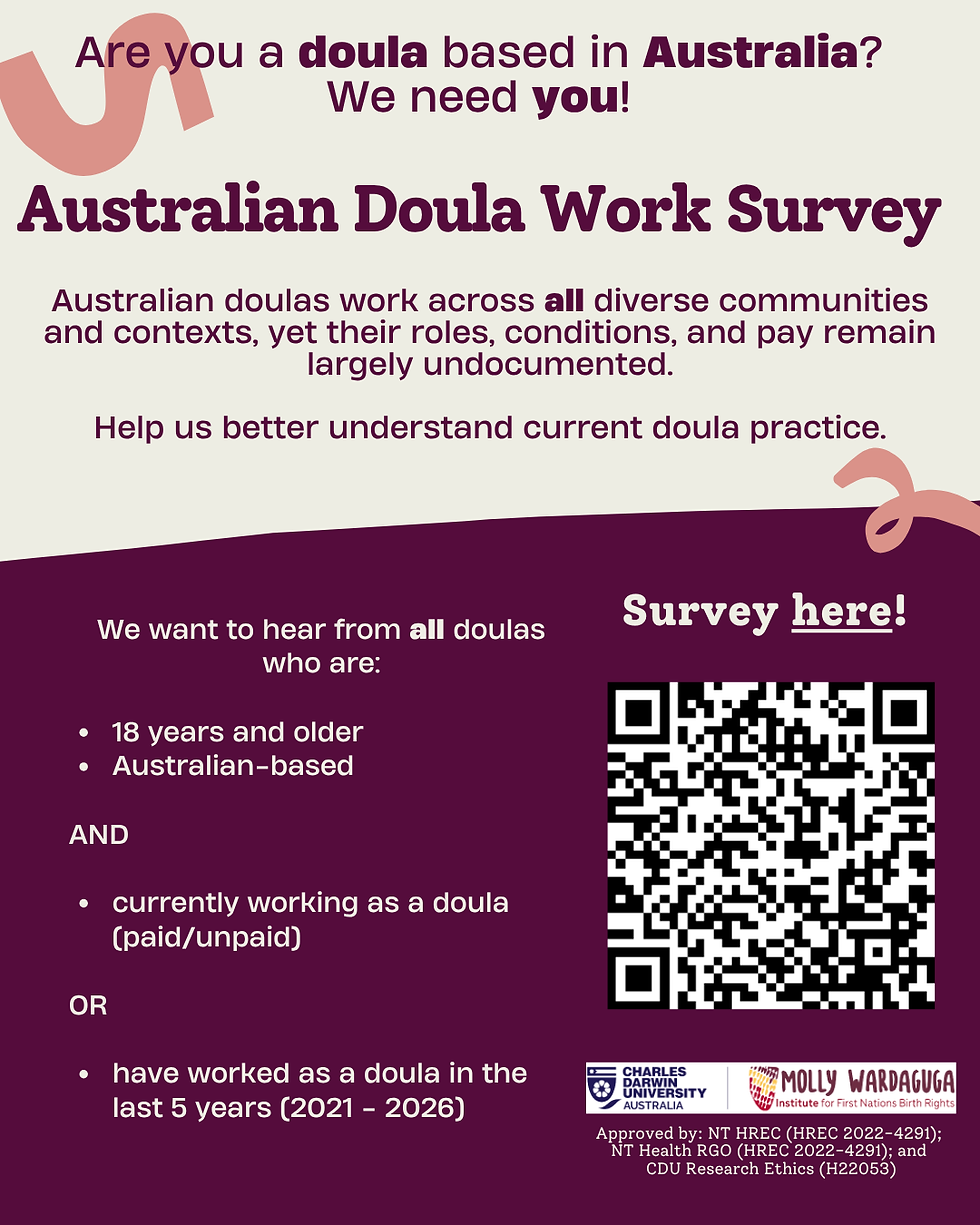
We are inviting all doulas who have practised in Australia within the last five years to participate in an anonymous national survey exploring:
Work models
Pay and conditions
Scope of practice
Sustainability of doula work
Barriers and opportunities within the workforce
Open until 7 July, this survey includes birth doulas, abortion doulas, postpartum doulas, and death doulas.
Our research is focused on addressing a major evidence gap in Australia. Despite growing recognition of the importance of relational and skilled companionship support, there is very little published evidence about doula work models, workforce conditions, and the contribution doulas make within Australian health and community settings.
We want to change that.
This survey forms part of the broader Molly Waradugua Institute led Pandanus Mat Partnership Project in North East Arnhem Land.
The project is exploring innovative approaches to community-based workforce development that respond to the realities faced by First Nations communities and the ongoing impacts of colonisation within mainstream maternity systems.
For many First Nations communities, entrenched inequities in education, workforce pathways, funding, and access to training continue to limit opportunities to develop and sustain their own locally based Western-trained midwifery workforce.
In this context, doulas and culturally grounded support workers can play a critical role by providing continuity, advocacy, cultural safety, and relational care to women and families navigating systems that are often culturally unsafe or disconnected from community needs.

Photo credit: Hannah Barata. Pexels
The findings from this survey will directly inform the ongoing refinement and development of the Djäkamirr Doula Model, helping strengthen evidence-informed approaches to doula practice, workforce sustainability, and community-led care.
As highlighted in our literature review on Indigenous doula practice:
“Indigenous doulas may provide an important culturally responsive strategy to improve Indigenous women’s experiences of maternity care and address gaps where Indigenous midwifery workforce capacity is limited.”
Ireland, Montgomery-Andersen & Geraghty (2019)
International evidence also suggests that First Nations doula models can play an important role in challenging the ongoing impacts of colonisation within maternity systems by supporting autonomy, cultural continuity, birth sovereignty, and community control over care.
Every response to this survey matters.
Building an evidence base will contribute to strengthening collective advocacy for recognition, investment, and workforce approaches that genuinely meet the needs of communities.
We also need your help to share this survey widely across the Australian doula community. Please send it to colleagues, networks, organisations, and friends who may be eligible to participate.
Together, we can help shape a future where culturally safe, relational, and community-led care is recognised as an essential part of Australia’s health workforce.
Learn more with these links
Ireland, S., Bukulatjpi, Y.D., Djota, E, Gundjarraŋbuy, R., Roe, Y., Moore, S., Kildea, S & Maypilama, E.L. (2024). Djäkamirr: Exploring principles used in the training First Nations doulas in a remote multilingual Northern Australian community setting. Women and Birth. doi: 10.1016/j.wombi.2023.12.007
Ireland, S., Montgomery-Andersen, R. & Geraghty, S. (2019). Indigenous doulas: A literature review of their role and practice in Western maternity care. Midwifery, 75, 52–58.
Ireland, S., Kildea, S. Moore, S., Roe, Y., & Adair, R. First Nations Doulas: Training needs and industry support in the Top End, Northern Territory, Australia. Women and Birth (2023) 36 (3) Women and Birth. doi: 10.1016/j.wombi.2022.11.007.
Photo credit: Pexels


Comments