2026: Strengthening Community Control and Service Delivery
- Dr Sarah Ireland

- Mar 4
- 4 min read
Gundungurra & Dharug Country, NSW, 4 March, 2026
When the Western calendar turns, we are often encouraged to pause and reflect on what has been achieved and what lies ahead. In community-led health services and research, there is rarely a clean break between one year and the next. The work continues across seasons, across holidays, across funding cycles, and across Country and Worlds. Like birthing itself, it unfolds in its own time.

Photo credit: Sarah Ireland. I work across Country and Worlds from Yolŋu to Gundungurra & Dharug Country where these words are written.
Those who work across different systems of knowledge will recognise that progress is rarely linear. It is relational and negotiated. It requires patience, clarity of purpose, and a sustained commitment to working with complexity in the cultural interface.
With the support of the Molly Wardaguga Institute and our valued research partners, this is the ground on which the Djäkamirr Project continues to grow.

Photo credit: Sarah Ireland. Wet season growth on Yolŋu Country.
Supporting Growth
We began the 2026 working year with the first joint meeting of the Gumurr'dhangiynamirr Advisory Board and DJÄKAMIRR Co-op Directors. This marked a significant milestone. In December 2025, the DJÄKAMIRR Co-op Ltd formally stepped into operational responsibility for djäkamirr service delivery. The transition from a university-based research project to a community-controlled and community-owned perinatal support service provider is substantial. It reflects years of groundwork and collective efforts.
At that first meeting of the year, eleven Yolŋu women directed discussion on both service delivery and community-driven research. The conversation was practical, passionate and focused: how the service is going, what is working, what requires adjustment, and how research findings are informing governance. The Board is looking forward to its Annual General Meeting with a special request put forward for a presentation on the Co-ops numba dhäwu- to share the number story around djäkamirr activities.
When research and service delivery are aligned under Yolŋu governance, outcomes shift. Decision-making becomes accountable to community priorities, and not external metrics alone. This is what system change looks like in practice.
This year we are consolidating the learning of the past four years to ensure the Djäkamirr Co-op Ltd is well supported to thrive. With the ongoing partnership of the Womb to Tomb Foundation, there are now thirteen graduate Djäkamirr, with further accredited training planned for later in the year. The program is experiencing a significant increase in activity, with eighteen women currently receiving care. This requires careful coordination between the Djäkamirr Co-op team, the djäkamirr and their clients, Cultural Knowledge Authorities and of course clinical service partners. The ambition remains clear: that every pregnant Yolŋu woman who wants a djäkamirr can access one.

Photo credit: Sarah Ireland. The team coordinating Djäkamirr service delivery
Our project PhD students, Theresa Clasquin and Jess Davis, continue to strengthen the intellectual and practical foundations of the project. Working alongside Yolŋu co-researchers, they are advancing scholarship in on-Country sexual assault care and addressing the persistent challenge of how numbers are used and communicated in health service delivery. We are looking forward to sharing their forthcoming publications later in the year.
Creative work is also moving forward. Professor Maypilama’s second documentary is nearing completion.
This project extends the reach of Djäkamirr Project beyond policy and academic audiences, contributing to raising public awareness and understanding of Yolŋu-led maternity reform. Recent visits to homelands to seek family permissions for the final film have reinforced that this work remains grounded in relationship and accountability. We look forward to sharing details of premieres and distribution, including a dry season event in Darwin.

Photo credit: Pascal our MAF Pilot. Professor Maypilama and Sarah Ireland visiting homelands to adhere to cultural consent processes.
Looking Forward
There is no illusion that the year ahead will be simple. Work that seeks to shift power, redesign services, and honour sovereignty rarely is. It involves negotiation, persistence, and a willingness to challenge established systems. It is also urgent and necessary work.
We enter 2026 with a clear commitment: to strengthen Yolŋu-led governance, to consolidate safe and effective Djäkamirr service delivery, to share our research findings and to continue building the workforce and resourcing required to return Birthing to Country.
On a personal note, my trusty fieldwork companion, my hat, has finally been refurbished! It still bears the visible signs of previous harsh use, but it is ready for several more seasons on Country. I really appreciate that it still has more life in it and know that I would suffer terribly without its welcoming shade. I am looking forward to using it for many more years to come.


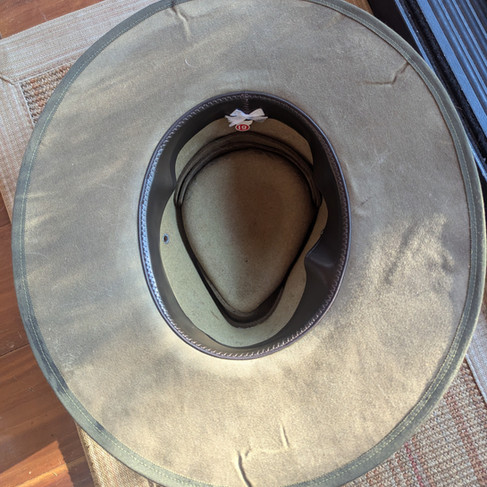
Photo credit: Sarah Ireland. Refurbished Territory Akubra
Stay Connected
If our work resonates with you as a partner, stakeholder, or supporter, we invite you to remain connected.
Share this update with colleagues, friends, or family who are committed to Yolŋu-led health reform and accountable systems change. Meaningful reform often advances through informed conversations carried across relationships. Your continued engagement helps ensure this work not only continues, but strengthens.
Learn more with these links:
Research partners

Comments